


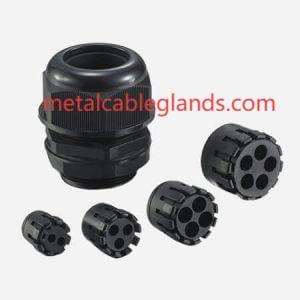
Long before most governments wrote net-zero targets into law, forward-thinking telecom operators and renewable developers already faced investor questionnaires demanding proof that every component in their multi-billion-dollar projects contributed to genuine decarbonization. In that scrutiny, the Plastic Cable Gland, once dismissed as a minor commodity, now stands as one of the easiest and most visible wins on the sustainability scorecard. Zhejiang Hongjuesi Connector responded by creating the industry’s first fully circular polyamide gland series that exceeds tomorrow’s regulations while outperforming yesterday’s metal alternatives.
The foundation is a bio-enhanced PA66 compound incorporating 40 % renewably sourced castor-oil-derived monomers (Sebacic acid replacement) without sacrificing mechanical strength or flame retardancy (V0 rating at 0.8 mm). Independent cradle-to-gate carbon accounting performed under ISO 14067 shows these glands emit 2.9 kg CO₂e per thousand pieces—approximately 63 % less than an equivalent brass gland and 41 % less than standard fossil-based nylon glands. When deployed across a 500 MW solar portfolio, the embodied carbon saving equals removing 180 passenger cars from the road for a full year, a figure that appears directly in annual ESG reports.
Recyclability was non-negotiable. Unlike traditional glands that mix brass inserts, nitrile rubber seals, and different nylon grades, Hongjuesi’s new series uses a single polymer family throughout, including the sealing ring and clamping cage. At end-of-life, the entire gland can be granulated and recompounded with zero down-cycling penalty. A closed-loop pilot already running with three major European wind operators has successfully returned 18 tonnes of decommissioned glands into new production batches maintaining 100 % of original tensile and sealing specifications.
Halogen-free and red-phosphorus-free flame retardance eliminates toxic smoke risk during cable fires—a growing concern as telecom edge sites move into multi-tenant buildings and battery storage containers are placed beside residential areas. The formulation also contains zero SVHC substances under REACH Annex XIV, giving procurement teams immediate compliance with the strictest upcoming chemical restrictions expected in 2027-2028.
Water utility is another overlooked sustainability metric. Traditional metal glands require anti-seize paste and frequent re-torquing that contaminate soil when dropped during rooftop or tower work. The new Plastic Cable Gland needs no lubricants, arrives pre-lubricated with a food-grade silicone that biodegrades harmlessly, and locks permanently at the correct torque via an integrated ratchet cap. Field loss rates in Southeast Asian 5G deployments dropped from 4.7 % with metal glands to 0.3 %, preventing thousands of small metal parts from entering waterways each year.
In offshore wind applications, where every kilogram lifted 120 metres costs real money and carbon, the 68 % weight reduction versus stainless-steel equivalents directly lowers helicopter and vessel fuel consumption. One North Sea developer calculated that switching to plastic glands across a 1.2 GW project saved 11 tonnes of lifted mass—equivalent to 29 fewer crane cycles and roughly 42 tonnes of CO₂ from reduced diesel burn.
Circular design extends to packaging: individually numbered flow-wrap bags have been replaced by reusable bulk totes with RFID tracking, cutting single-use plastic by 97 % at the factory gate. Customers who return the totes receive credits against future orders, creating a financial incentive loop that has already achieved 89 % return rate in Germany and the Netherlands.
The same glands now protect the fibre and power cables feeding green hydrogen electrolysers, rural broadband networks powered entirely by micro-hydro, and the 5G private networks that enable remote shutdown of solar farms during grid emergencies—each application demanding components whose environmental credentials match the clean energy they serve.
Investors and regulators no longer accept vague promises about future sustainability. They want third-party verified data today. Hongjuesi publishes full Environmental Product Declarations (EPDs) under EN 15804+A2 for every size in the range, complete with take-back certification and closed-loop test reports. Specifiers can download the exact carbon, water, and circularity numbers to plug directly into their own project-level life-cycle assessments.
For engineering teams that must deliver hard proof that their cable management choices actively reduce environmental impact rather than merely comply, the decision has become straightforward. A new generation of plastic cable glands has arrived that turns a once-invisible component into a measurable contribution toward binding 2030 and 2050 targets.Explore the complete bio-enhanced, closed-loop range and download the verified EPDs at https://www.metalcableglands.com .

 English
 Arabic
 French
 Spanish
 Portuguese
 Deutsch
 Turkish
 Dutch
Dutch
 Italiano
 Russian
 Romaian
 Portuguese (Brazil)
 Greek
Greek