


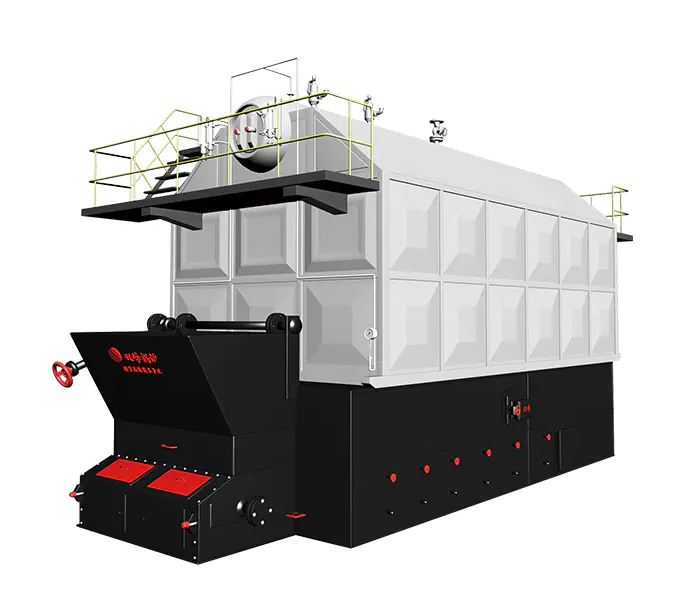
In the dairy processing industry, steam demand is not constant; it swings wildly between pasteurization cycles and cleaning (CIP) processes. A facility in Europe faced soaring oil prices and turned to a Solid Fuel Steam Boiler to maintain its profit margins. The specific requirement was a system capable of responding to load changes from 8 tons per hour to 32 tons per hour rapidly—a notoriously difficult task for solid fuel due to its slow response time.
The solution involved a bi-drum water tube Solid Fuel Steam Boiler fitted with spreader stokers. This design allowed the fuel to burn partly in suspension, providing the rapid response needed. The technical parameters of the installation were specific: steam at 67 bar and 420°C (superheated), feeding a turbine for combined heat and power (CHP) before extraction for process use. The total project demonstrated that a Solid Fuel Steam Boiler could achieve an overall system efficiency of 91.5% when burning coal, dropping slightly to 79.4% when mixing in peat briquettes.
The results indicated that while the combustion efficiency was acceptable, fuel handling required "significant readjustments." The variability of solid fuel (specifically the mix of coal and peat) led to combustion control problems unless pre-blended carefully. This real-world example teaches a critical lesson: the boiler hardware is only as good as the fuel preparation system. For any Solid Fuel Steam Boiler, investing in a homogenizing fuel yard and moisture meters is as important as the boiler itself.
Furthermore, the case study highlighted the economics. The payback period for installing the Solid Fuel Steam Boiler was calculated at under three years, based on the price difference between waste wood/coal and imported heavy fuel oil. The maintenance costs, however, shifted from burner nozzles (oil) to grates and ash conveyors (solid fuel). The dairy had to install a new dense-phase fly ash collection system to manage the 5-7 tons of ash produced weekly. This proves that while a Solid Fuel Steam Boiler saves money on fuel, the savings must be reinvested into material handling and emission control systems to keep the plant running smoothly.

 English
 Polski
 Arabic
 French
 Spanish
 Portuguese
 Turkish
 Dutch
Dutch
 Italiano
 Russian
 Romaian
 Portuguese (Brazil)
 Greek
Greek