


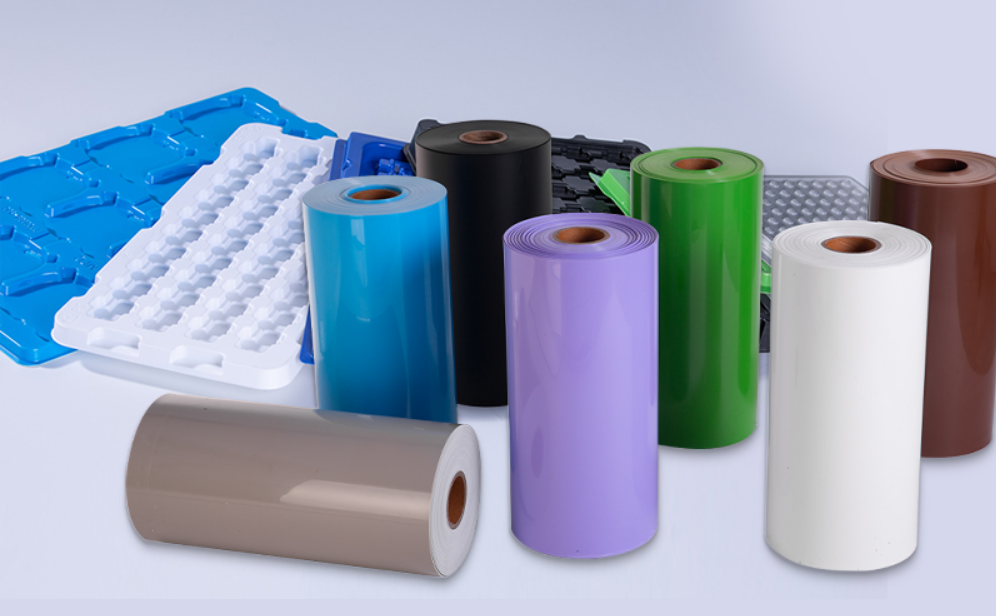
Selecting the correct raw material is the first step in a complex manufacturing dance. Whether you are a converter producing reels or an OEM buying them, understanding the journey of Sheets for carrier tape helps in specifying the right product. Here is a step-by-step guide to the parameters that matter.
Step 1: Extrusion and Annealing
It begins with resin. Whether PS, PC, or PET, the pellets are melted and extruded through a flat die. However, rapid cooling can freeze internal stresses into the sheet. To make reliable Sheets for carrier tape, manufacturers often perform an annealing process—heating the rolled sheet at 50°C to 120°C for several hours. This increases crystallinity in materials like Polybutylene Terephthalate (PBT), which stabilizes the molecular structure and prevents the finished carrier tape from shrinking later -7.
Step 2: The Forming Process (Heat vs. Pressure)
The sheet is fed into a press. There are two primary methods: punch forming (mechanical) and vacuum forming (air pressure). For fine pitch components, mechanical punch forming using a matching male/female die set is preferred. Here, the Sheets for carrier tape must have a "Tensile Elongation at Yield" of at least 150-200% -1. If the sheet is too brittle, the deep draw of a pocket (sometimes 2mm deep) will cause stress-whitening or cracking.
Step 3: ESD Control Layering
You must decide between surface coating and co-extrusion. Co-extruded Sheets for carrier tape are generally superior for critical applications because the conductive layer (carbon) is embedded in the middle of the three-layer sandwich (A/B/A). This protects the conductive path from scratching. A coated sheet, while cheaper, loses its antistatic properties if the top coating wears off against the forming tooling. Check the "Surface Resistivity" spec; it should remain stable even after elongation.
Step 4: Siltion and Edge Quality
After forming, the sheet is slit to width (e.g., 8mm, 12mm, 16mm). A poorly slit edge creates "burrs"—microscopic plastic hairs. When the cover tape is sealed over the pockets, these burrs create micro-channels that allow moisture ingress or cause the cover tape to lift (delamination). Quality Sheets for carrier tape will have "low burr" grades specifically designed for clean slitting, ensuring a smooth edge that seals tightly.
By auditing these four steps, you ensure that the final product will survive vibration, vacuum picking, and long-term storage.

 English
 Polski
 Arabic
 French
 Spanish
 Portuguese
 Turkish
 Dutch
Dutch
 Italiano
 Russian
 Romaian
 Portuguese (Brazil)
 Greek
Greek