


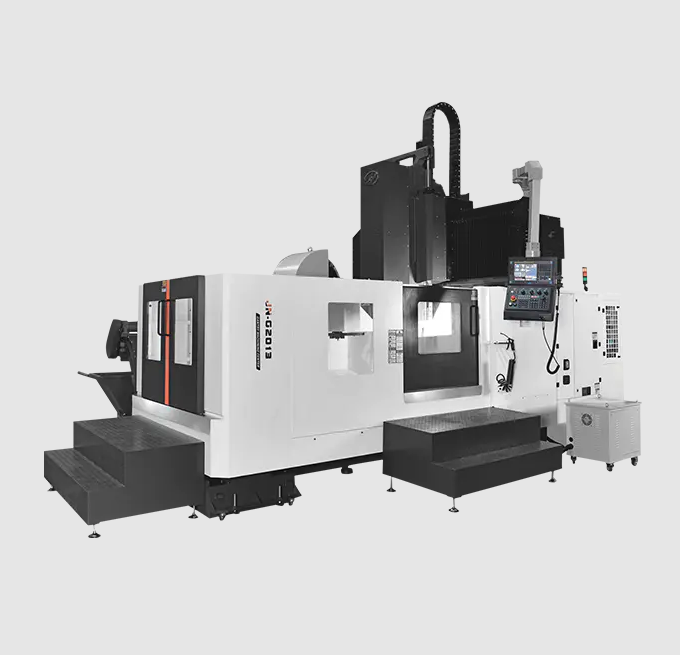
When machining large components, maintaining precision across long travel distances becomes a significant engineering challenge. This is one of the main reasons gantry structures are widely used in industrial CNC applications.
A CNC Gantry Machine features a stationary worktable and a moving bridge structure that spans across the machining area. This configuration reduces uneven stress distribution and helps maintain accuracy during extended cutting paths.
In technical discussions, one commonly mentioned issue in large CNC systems is vibration-induced deviation. Gantry structures address this by using reinforced beams and linear guide systems that improve rigidity. This helps maintain consistent tool engagement even during high-speed cutting.
A CNC Gantry Machining Center is often selected for applications requiring long and flat surface machining, such as guide rails, structural beams, and mold bases. The ability to maintain consistent depth and alignment over long distances is critical in these applications.
Another important aspect is thermal stability. Large machining operations generate heat over extended cycles, which can influence dimensional accuracy. Gantry systems are typically designed with stable structural materials to minimize thermal deformation effects.
Overall, precision in large-format machining depends heavily on structural rigidity, motion stability, and controlled tool paths—all of which are key design features in gantry CNC systems.

 Polski
 Arabic
 French
 Spanish
 Portuguese
 Deutsch
 Turkish
 Dutch
Dutch
 Italiano
 Russian
 Romaian
 Portuguese (Brazil)
 Greek
Greek