


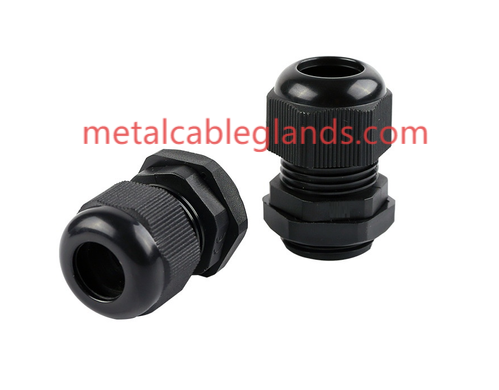
When mobile network operators race to light up thousands of new 5G macro sites and small-cell nodes before competitors, every hour saved in the field translates directly into market share. The same pressure now hits large solar developers racing to meet aggressive COD (commercial operation date) deadlines driven by power purchase agreements. In both scenarios, the Plastic Cable Gland has quietly become the component that separates weeks-long delays from on-schedule energization. Zhejiang Hongjuesi Connector recognized this years ago and redesigned its entire nylon gland series around one principle: install faster without sacrificing sealing performance.
Traditional metal glands require anti-seize compound, two wrenches, precise torque values, and often an internal locknut—steps that feel trivial in a lab but become maddening when a technician is hanging off a monopole at dusk in the rain. The latest Plastic Cable Gland from Hongjuesi eliminates nearly all of that. A patented snap-lock cap and pre-assembled sealing ring mean the gland is ready straight from the bag. The installer simply pushes the cable through, folds the armor stop (if present), and hand-tightens the cap until an audible click confirms correct compression. Independent timing studies on European 5G deployments showed average installation drop from 4.8 minutes per penetration with metal SWA glands to 42 seconds with these plastic versions—an 85 % reduction that compounds dramatically when a single rooftop site has forty or fifty entries.
Solar contractors face similar math. A 150 MW ground-mount plant typically has over 8,000 combiner-box penetrations and another 1,200 at the inverter stations. Shaving even thirty seconds off each gland installation saves more than 100 man-days across the project. On recent installations in Rajasthan and Texas, crews using Hongjuesi’s quick-mount plastic glands consistently finished string wiring two to three weeks ahead of schedule, allowing earlier inverter commissioning and faster revenue flow. The glands’ integrated cable retention clip also removes the need for separate clamps inside the box, further reducing component count and potential failure points.
Another hidden time sink is cable preparation. Many plastic glands on the market still demand that installers strip the exact length of outer sheath or risk compromising the seal. Hongjuesi’s multi-stage sealing lip design tolerates ±15 mm variation in strip length while maintaining IP68 immersion rating, meaning technicians no longer measure twice and cut once—they simply strip approximately and keep moving. In small-cell deployments along urban light poles, where crews often work at night under traffic control, this tolerance alone has prevented countless return visits.
Renewable projects increasingly overlap with private LTE and 5G networks for remote monitoring and predictive maintenance. A single desert solar farm might now host several hundred IoT gateways, each requiring weatherproof Ethernet or fiber entry. The same plastic gland family serves both power and data cables because the sealing element automatically adjusts to different jacket diameters within a single gland size. Procurement teams love stocking only three or four SKUs instead of dozens, and warehouse errors virtually disappear.
Cold-weather deployments add another layer of difficulty. In Canadian telecom expansions and northern European wind projects, metal domes become brittle below -20 °C and can crack during tightening. High-impact PA66 formulations used by Hongjuesi remain flexible down to -40 °C, letting winter crews maintain full installation speed without switching to special low-temperature variants or waiting for daylight warming.
Perhaps most importantly, the glands pass the “one-person, one-tool” test. No second wrench, no torque screwdriver, no thread tape—just a standard open-end spanner for the body if extra security is desired. When a crew of four can seal an entire 5G site before lunch and move to the next, or when a solar string crew finishes a 5 MW block in a single shift instead of two, project managers stop treating cable glands as commodities and start treating them as schedule-critical assets.
Speed without reliability is worthless, of course. These glands still carry TÜV and UL 514B certification, 25-year salt-spray validation, and full compliance with the latest IEC 62444 strain-relief standards. They simply deliver that reliability in a fraction of the time previous solutions demanded.For teams under crushing deadlines—whether densifying urban 5G coverage or racing to energize the next gigawatt-scale solar plant—the right plastic cable gland is no longer a minor detail; it is a competitive weapon. Explore the complete quick-install series and downloadable installation videos at https://www.metalcableglands.com .

 English
 Arabic
 French
 Spanish
 Portuguese
 Deutsch
 Turkish
 Dutch
Dutch
 Italiano
 Russian
 Romaian
 Portuguese (Brazil)
 Greek
Greek