


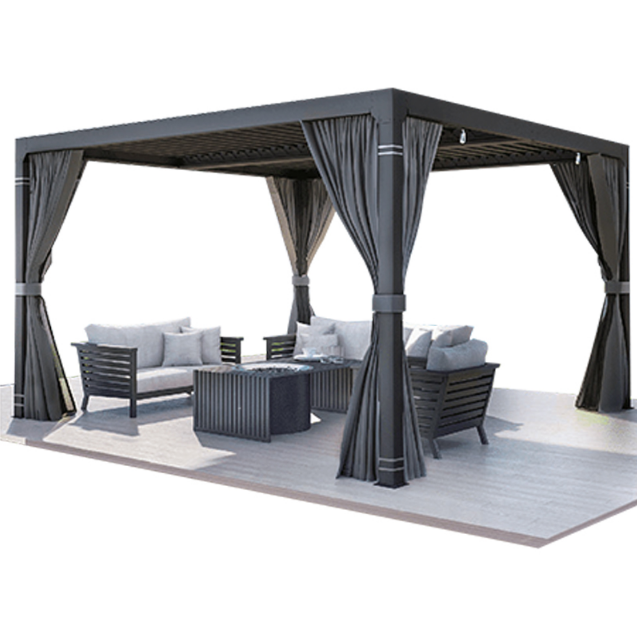
In modern landscape design, the Outdoor Privacy Gazebo is used as a transitional structure between indoor living and open garden environments. It acts as a spatial divider while maintaining visual harmony with surrounding elements.
Architecturally, these structures are often designed with geometric symmetry—square, rectangular, or octagonal footprints. Sizes typically range from compact 3x3 meter installations to larger 4x5 meter layouts for family use.
Material combinations are selected to match outdoor aesthetics. Aluminum frames with wood-grain coating are commonly used to blend modern durability with natural visual tones. Roof structures may include soft fabric canopies or rigid polycarbonate sheets depending on design intent.
Privacy integration is achieved through layered enclosure systems. These include sliding curtains, mesh screens, and partial wall panels. Curtain fabrics generally have GSM ratings between 200 and 280, balancing opacity and breathability.
The Outdoor Privacy Gazebo also contributes to zoning within outdoor spaces. It defines areas for dining, relaxation, or social interaction without permanent construction. Designers often position it near gardens, water features, or decking areas to enhance spatial flow.
Lighting integration is another growing design element. Many installations include LED strip lighting systems or solar-powered fixtures to extend usability into evening hours.
From a design perspective, this structure functions as both a visual anchor and a functional shelter, enhancing usability while maintaining openness in the overall landscape.

 English
 Polski
 Arabic
 French
 Spanish
 Deutsch
 Turkish
 Dutch
Dutch
 Italiano
 Russian
 Romaian
 Portuguese (Brazil)
 Greek
Greek