


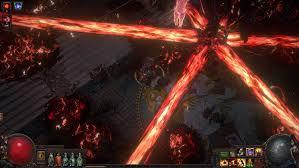
 In an era where most games cushion failure with generous checkpoints, auto-saves, and respawn mechanics, Path of Exile offers a stark alternative: the Hardcore league. In this mode, death is permanent. When a Hardcore character’s health reaches zero, that character is immediately moved to the Standard league, where they can still be played but are removed from the Hardcore economy and leaderboards. There are no second chances, no resurrection scrolls, no near-death recovery mechanics. A single mistake, a single lag spike, a single misjudged boss mechanic can end dozens or hundreds of hours of progress. For the players who choose this mode, the risk is not a deterrent but the entire point.
The Hardcore experience in Path of Exile fundamentally changes how the game is played. In Standard, players optimize for damage output, seeking to clear screens of monsters as quickly as possible. In Hardcore, players optimize for survival, prioritizing life, resistances, and defensive layers over raw damage. A Hardcore character might invest passive points in life nodes before damage nodes, equip a shield instead of a second weapon, and carry multiple instant recovery flasks. The meta shifts; builds that are popular in Standard may be considered too risky for Hardcore, while builds that are slow but safe become desirable. The player’s behavior changes as well. A Hardcore player will retreat from a dangerous pack, portal out of a boss fight to reset flasks, and over-level content rather than pushing the edge of what is possible.
The economy of the Hardcore league differs dramatically from Standard. Because characters die and are removed from the economy, items are constantly being consumed. A best-in-slot chest piece that a Standard player might use for months could be lost in a Hardcore player’s death within hours of being equipped. This consumption creates demand; items that are common in Standard may be rare and expensive in Hardcore. Conversely, items that are useful for leveling new characters—low-level unique items, leveling gear with life and resistances—hold their value throughout a Hardcore league, as players inevitably die and restart. The Hardcore economy is a market shaped by mortality, a system where every transaction carries the implicit knowledge that the item being sold may outlive the buyer.
The social dynamics of Hardcore are also distinct. The Hardcore community is smaller than Standard but tighter-knit, with players recognizing each other’s names across leagues. Death announcements appear in global chat, creating moments of shared mourning or schadenfreude. A player who reaches level 100 in Hardcore has achieved something genuinely impressive, a feat that requires not only skill and knowledge but also discipline and luck. The leaderboards track the highest-level Hardcore characters, and the race to be the first to reach endgame content at the start of a new league is a spectator event, streamed and celebrated by the community.
The Hardcore mode is not without its frustrations. Technical issues—server disconnects, lag spikes, crashes—can kill a character through no fault of the player, a reality that Hardcore veterans accept with grim resignation. The time investment required to reach endgame in Hardcore is substantial, and a single death can be devastating, particularly for players with limited playtime. Some players find the stress of permadeath exhausting, preferring the more forgiving Standard experience. Yet for the players who embrace the challenge, Hardcore offers something no other mode can: stakes. Every combat matters. Every retreat is a decision. Every moment of survival is an accomplishment. In Path of Exile 3.28 Currency’s Hardcore league, death is always watching, and that is precisely the point. To play Hardcore is to accept that every character is temporary, and to find meaning in the journey rather than the destination.

 English
 Arabic
 French
 Spanish
 Portuguese
 Deutsch
 Turkish
 Dutch
Dutch
 Italiano
 Russian
 Romaian
 Portuguese (Brazil)
 Greek
Greek